
Reviewed by Alex Davis, Esq. – Admitted in Arizona, California, New Jersey, New York, Pennsylvania · Last reviewed Oct 8, 2026
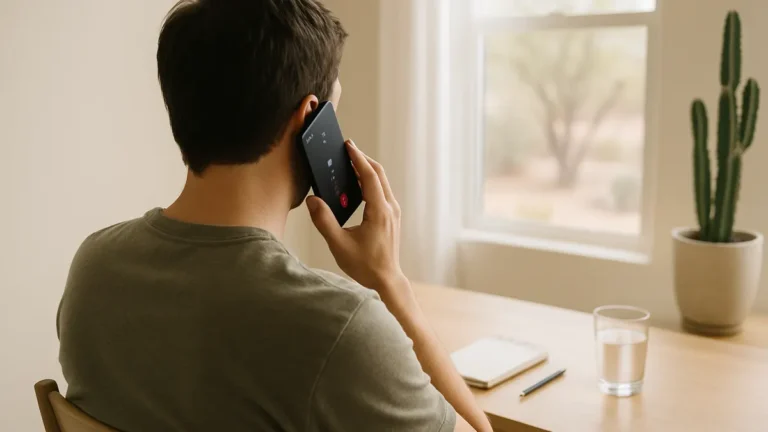
Yes. Arizona is a one-party consent state: a participant can ordinarily record a phone call or in-person conversation without obtaining every other participant’s consent (A.R.S. § 13-3005; § 13-3012). Federal law and the laws of another state can still limit a particular recording (18 U.S.C. § 2511).
Before recording, identify who will participate, where they are located and what the device will capture. A recording of your own conversation raises different questions from a microphone left running to capture other people.
What do Arizona’s recording laws allow?
A.R.S. § 13-3005(A) prohibits intentional interception of a wire or electronic communication when the recorder is not a party and neither the sender nor receiver consents. It also addresses intentional interception of a conversation or discussion at which the recorder is not present, without a participant’s consent; applicable exemptions appear in § 13-3012.
For an ordinary Arizona-only telephone call, your participation supplies the basis for one-party consent. Someone outside the call can also record with a participant’s consent; “one-party” does not mean that nobody needs to agree (A.R.S. § 13-3012(9)).
Federal law independently permits private recording by a participant or with a participant’s prior consent, unless the interception is for a criminal or tortious purpose. A state-law exemption does not erase that separate requirement (18 U.S.C. § 2511(2)(d)).
Can someone who is present but not participating record?
Arizona’s exemption expressly refers to consent from “a party to the communication or a person who is present during the communication.” That wording is broader than a rule referring only to participants (A.R.S. § 13-3012(9)).
But physical presence alone does not satisfy the federal private-person consent exception, which requires participation or a participant’s prior consent (18 U.S.C. § 2511(2)(d)). An assistant attending a meeting or someone working at a nearby desk should not assume that being within earshot makes every recording lawful.
For a nonparticipant, obtain a participant’s permission before recording and assess any other applicable restrictions. Do not rely on the phrase “one-party state” as permission to capture unrelated conversations after the consenting person leaves.
Does the location or expectation of privacy matter?
Arizona defines an “oral communication” by the speaker’s expectation against interception under circumstances that justify that expectation. However, the operative provision uses “conversation or discussion” rather than that defined term, so the wording should not be reduced to a simple public-place exemption (A.R.S. § 13-3001; § 13-3005).
In State v. Hauss, 688 P.2d 1051 (Ariz. Ct. App. 1984), the Arizona Court of Appeals held the statute inapplicable to a conversation in a police-station interview room under the circumstances presented because there was no reasonable expectation of privacy. That decision does not establish that every conversation in a store, restaurant or open office can be recorded secretly.
Treat location as part of the analysis, not a substitute for consent. If you are not participating, get advice before relying on the surrounding setting.
What if someone on the call is in another state?
Do not assume Arizona’s one-party consent rule settles an interstate recording question. Courts may examine the participants’ locations, where the recording occurred and the choice-of-law rules applicable to the dispute (Xcentric Ventures LLC v. Borodkin, No. 2:11-cv-01426 (D. Ariz. Jan. 9, 2013)).
In Xcentric Ventures, a federal court applied Arizona law to calls a California resident initiated to an Arizona business and that were recorded in Arizona, based on the dispute’s specific contacts (Xcentric Ventures). The court ruled for the business because the claimant relied on California law and identified no Arizona law making the conduct unlawful (Xcentric Ventures, summary-judgment order). California’s Supreme Court reached a different choice-of-law result in Kearney, allowing a claim to stop a Georgia business’s undisclosed recording of California clients to proceed under California law (Kearney v. Salomon Smith Barney, Inc., 39 Cal. 4th 95 (2006)).
For an Arizona business handling interstate calls, obtaining everyone’s consent before recording is the more cautious operating policy. Treat that as a practical safeguard, not a statement that every interstate call legally requires all-party consent. Our state-by-state recording consent guide provides an overview of state-law differences.
What other recording exceptions does Arizona recognize?
The exemptions are specific to the activity and circumstances. A.R.S. § 13-3012 includes certain service-provider operations, publicly accessible electronic communications, authorized law-enforcement interception and narrowly defined child monitoring.
The child-monitoring definition concerns supervision or safety by a parent, guardian or responsible person in that person’s own residence. It is not a general exemption for workplace microphones (A.R.S. § 13-3001(2); § 13-3012(14)).
Video needs a separate scope check. Recording audio through a camera raises conversation-recording questions, while Arizona’s separate surreptitious-recording statute, § 13-3019, protects against specified intimate or private visual recording and disclosure; one-party audio consent does not settle those issues.
What are the penalties for illegal recording in Arizona?
Unlawful interception covered by A.R.S. § 13-3005(A) is a class 5 felony. Recording without telling another person is not automatically that offense: consent, participation and statutory exemptions still matter.
For a first non-dangerous felony governed by A.R.S. § 13-702, the ordinary minimum is nine months, the presumptive term is 1.5 years and the ordinary maximum is two years. The mitigated and aggravated endpoints extend from six months to 2.5 years; probation may be available to an eligible defendant.
Those figures are not a prediction for a particular case. Prior convictions, the applicable sentencing provisions and the facts can change the consequences.
Can someone sue over an unlawful Arizona recording?
Yes. A.R.S. § 12-731 permits a civil action for communications intentionally intercepted, disclosed or used in violation of Arizona’s wiretap chapter, subject to its exceptions. The damages measure is the greatest of:
- Actual loss and profits: The claimant’s actual damages plus the violator’s profits resulting from the violation.
- Daily statutory damages: $100 for each day of violation.
- Statutory amount: $10,000.
The statute also provides for appropriate equitable relief, punitive damages in appropriate cases, and reasonable attorney fees and litigation costs. A claim must be brought within one year after the claimant first has a reasonable opportunity to discover the violation; these provisions do not mean every disputed recording results in an award (A.R.S. § 12-731).
A separate federal civil claim may be available when the federal Wiretap Act is violated. Its requirements and two-year discovery-based limitation differ from Arizona’s remedy (18 U.S.C. § 2520).
Can a recording be used in an Arizona court?
A recording’s lawfulness does not, by itself, resolve whether it can be used as evidence. Unlawfully intercepted wire or oral communications and evidence derived from them may be barred where disclosure would violate the federal chapter (18 U.S.C. § 2515).
Preserve the original file rather than only an edited clip. Ask counsel to assess consent, authentication, relevance, hearsay and other applicable rules before submitting or circulating it.
Can you record police in Arizona?
Yes, the right to record officers carrying out public duties is recognized in the Ninth Circuit, subject to lawful restrictions. Do not interfere with officers or assume the right authorizes trespass or unrestricted recording in every government facility (Reporters Committee’s Arizona guide).
Arizona’s 2022 eight-foot video-recording restriction, HB 2319, was blocked before its scheduled effective date. The federal court entered a permanent injunction and declaratory judgment on July 21, 2023; the restriction should not be presented as an enforceable eight-foot rule (Arizona Broadcasters litigation record).
How should an Arizona business handle recording?
An Arizona-only customer call can ordinarily be recorded without the customer’s consent when an employee participating in the call has consented to the recording (A.R.S. § 13-3012(9)). Confirm that consent and assess federal law and any other applicable restrictions rather than assuming employment alone authorizes recording (18 U.S.C. § 2511).
Document how notices work, when recording starts, how late arrivals are handled and who can access stored files. Check conference-platform defaults and vendor settings rather than assuming that an employee’s presence authorizes every automated capture.
Our call recording compliance guide addresses broader business procedures. Omni Law P.C.’s outside general counsel services can help Arizona businesses review recording policies, employee instructions and vendor agreements.
Frequently Asked Questions
Is Arizona a one-party or two-party consent state?
Arizona is a one-party consent state. One participant’s consent ordinarily satisfies its recording-consent rule; federal law and another state’s requirements may also apply (A.R.S. § 13-3012(9); 18 U.S.C. § 2511).
Can I record an Arizona phone call without telling the other person?
For an ordinary call confined to Arizona, a participant generally need not obtain the other participant’s consent under Arizona law. Federal law excludes interception for a criminal or tortious purpose from its private-person consent exception (A.R.S. § 13-3005; 18 U.S.C. § 2511(2)(d)).
Is it illegal to record a conversation if I am not part of it?
It can be, but a nonparticipant may record with a participant’s prior consent under the ordinary state and federal consent exceptions. Without applicable consent or authorization, do not assume the “one-party” label permits interception (A.R.S. § 13-3012; 18 U.S.C. § 2511).
Can I record just because I am in the room?
Arizona’s exemption includes consent from a person present during the communication. Federal law’s private-person consent exception instead requires participation or a participant’s prior consent, so mere presence is not sufficient under that exception (A.R.S. § 13-3012(9); 18 U.S.C. § 2511(2)(d)).
Does Arizona’s rule apply when I call someone in another state?
Arizona’s rule alone may not resolve a cross-border call. Other states distinguish communications differently; obtain the required consent before recording rather than assuming your own location controls (state-by-state recording guide).
What is the penalty for illegally recording someone in Arizona?
The interception offenses in § 13-3005(A) are class 5 felonies. Sentencing depends on the applicable provisions and circumstances; civil claims may also arise (A.R.S. § 13-3005; § 13-702; § 12-731).
Is Arizona’s eight-foot police-recording rule enforceable?
The 2022 restriction was blocked, with a permanent injunction entered in July 2023. That does not eliminate other lawful restrictions on recording or permit interference with police duties (Arizona Broadcasters litigation record; Reporters Committee’s Arizona guide).
Can I use a secretly recorded conversation in court?
Possibly; secrecy alone does not decide lawfulness or admissibility. Have counsel review the recording’s origin and the applicable evidence rules, including federal restrictions where relevant (18 U.S.C. § 2515).
Review your business’s recording policy
For help with an Arizona business’s recording practices, notices or vendor terms, call Omni Law P.C. at (844) 354-1234. Start with a brief description of the issue rather than sending a recording before counsel advises how to provide it.
Last reviewed: October 8, 2026.
Attorney Advertising. This article provides general information, not legal advice. Reading it or contacting Omni Law P.C. does not create an attorney-client relationship. Legal requirements depend on the circumstances and may change; consult an attorney about your situation.